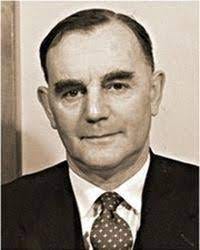
In the wake of Cecil Powell’s spectacular success in cosmic ray research, scientists and technicians designed and built machines with which it was possible to accelerate particles to high energies to bombard atomic nuclei. Cosmic rays were unpredictable and haphazard in their energies whereas in the particle accelerators physicists could control the energies of their bullet particles and target them on atomic nuclei with precision. This was the advent of high energy research and the particle accelerators came to be known as high energy laboratories. The outcome of this research combined with quantum mechanics came to be known as The New Physics. The crowning achievement of high energy nuclear research was an entirely new understanding of matter described as quark theory.
On the 27th January 1977, a BBC Television programme, The Key to the Universe, reported on the new physics. In a companion book to this programme, under the same title, Nigel Calder wrote about how high energy research led to the theory for quarks:
“In the early 1930s the contents of the Universe seemed simple. From just three kinds of particles, electrons, protons and neutrons you could make every material object known at the time. Thirty years later human beings were confronted with a bewildering jumble of dozens of heavy, apparently elementary particles, mostly very short lived. They came to light either in the cosmic rays or in experiments with the accelerators. The particles had various mass-energies and differing qualities such as electric charge, spin, lifetimes and so forth. Moreover they were given confusing, mostly Greek names so that one of the most eminent of physicists, Enrico Fermi, was driven to remark before his death in 1954, “If I could remember the names of all these particles I would have been a botanist.”
“The proliferation could be understood, to some extent, in that many of the particles seemed to be energetic relatives of the proton. Because they possessed greater inherent energy their masses were greater. Each was in some sense less tightly bound together than a proton and it could quickly change into a proton with a release of binding energy and an associated loss of mass. But that implied the proton was not a truly basic particle: it was made of something else, which could be bound more or less tightly together.
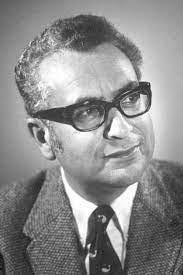
“A small group of theorists brought order out of chaos. The principle figure amongst them was Murray Gell-Mann of Caltech (The California Institute of Technology), then in his early thirties. He declared that all the heavy particles of nature were made out of three kinds of quarks. He had the word from a phrase of James Joyce ‘Three quarks for Muster Mark.’ It was the mocking cry of gulls, which Gell-Mann took as referring to quarts of beer, so he pronounced quark to rhyme with ‘stork’. Many other physicists rhymed it with ‘Muster Mark’. In German, as skeptics were not slow to notice, ‘quark’ rhymed with Mark was slang for nonsense....” 1
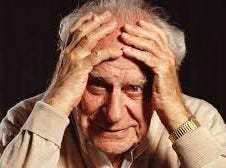
There is a lot in a name and the quark theory is nonsense, as the name suggests, not because of mocking gulls but because of a black swan. Karl Popper’s analogy of black and white swans, used to explain that science is not in the business of proving theories but rather of disproving them, 2 can be applied to quark theory. Quark theory is a white swan belief system that is doomed because there is a black swan, a single obvious fact, which makes it clear that the theory cannot be true.
The black swan for the quark theory is the proton. The single fact, which throws the quark theory into question, is the disparity in life span of the proton and practically all other particles discovered in the 20th Century. The lifespan of a proton has been estimated at 1033 years, 1 that is a billion, trillion, trillion years, whereas one ten billionth of a second is considered a strangely long lifespan for any of the new particles found in high-energy research. As spontaneous proton decays have never been observed, the proton can be treated as being infinitely more stable than any of the new, heavy particles that have come to light in the accelerators. Physicists call the heavy particles baryons from the Greek word for heavy. They account for the difference in lifespan between protons and other baryons in a law called the law of conservation of baryon numbers. However, this law doesn’t tell us why protons live for so much longer than the other particles it simply states, mathematically, that they do so. It is just one of the many instances in science where a statement is made that phenomena are observed to behave in a certain way, but no reason is given for why this is so.
With over 31 million seconds in a year, the difference between the estimated lifespan of a proton and one of the new particles is a figure in excess of 3 x 1050 (3 with fifty zeros behind it). Mathematicians use the number 1050 as a cut off point for probability. If the probability of something happening is less than 1 in 1050 then scientists are forced to accept that it never occurs. With a difference in stability in excess of 1050 it can be argued that it is improbable if not impossible for protons to be the same as other baryons, unless a very good reason is given for the disparity in their life spans.
This point is borne out by an analogy with building sites. Imagine walking down a road between two building sites. On the site to the left, the houses disintegrate as soon as they are built. Within a fraction of a second of the last lick of paint being applied, they vanish. On the site to the right the houses are advertised for sale with a trillion-year guarantee. It would be crazy to assume that identical bricks and mortar and construction techniques are employed on both building sites without providing an account for the difference in the durability of the houses. Yet in physics today physicists claim protons and all other baryons are constructed of quarks cemented together by gluon bonds.
There are believed to be six different types of quark bound in triads by gluon bonds. People who believe the quark theory accept that different combinations of three quark bricks, cemented together with gluon bonds, give rise to all the baryons houses, including protons. But they don’t explain why protons are infinitely more durable than all the other particles in the new particle zoo. Quarks could be used to explain protons, or they could be used to account for the other baryons, but not both. To use quark theory to explain only protons would be pointless, because the theory was invented to explain the particle zoo. But if quark theory provided an explanation for all the baryons apart from the proton it would still be pointless because the great bulk of the mass of the physical Universe consists of protons, whereas the other baryons - apart from the neutron - have been observed only in high-energy experiments. If the theory were to exclude protons the entire worldwide programme of high-energy research, which dominates physics, would be meaningless.
Physicists talk about discovering new particles of matter in the high-energy research but to say they have been discovered is misleading because discovery implies that something already exists and is waiting to be found. The short-lived baryons have been created out of the massive amounts of energy fed into the high-energy particle accelerators. These new heavy particles have been synthesized in an accelerator. They have no place in normal matter. They are just anomalies of high-energy research.
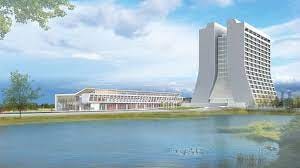
When the discovery of the top-quark was announced at Fermilab in April 1994, Jim Dawson opened his report in the Minneapolis Star Tribune with the following statement:
So there we have it, after more than two thousand years of searching, all of the fundamental stuff of Democritus’ atom has been revealed. The crowning moment came a couple of weeks ago when physicists announced that a gigantic, 5,000-ton machine apparently had detected a very small particle called the top-quark. 3
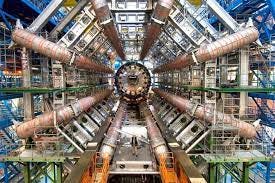
The physicists at Fermilab in Illinois didn’t actually see a quark. What they saw was the tracks of a jet of electrons and muons which they supposed to be the breakdown products of W-particles which they took to be the remnants of a top-quark. The recent ‘discovery ‘of Higgs Boson at CERN was an interpretation of similar fallout. No one ‘saw’ the boson. What they saw was debris from ‘atom bashing’ which they interpreted as the trail of a Higgs Boson.While every-thing in the world is supposed to be made of quarks not a single quark has ever been observed in a free state - even though no expense or effort has been spared in the effort to find one.
Physicists reason that a quark has never been observed in the free state is because it is impossible to have a gluon bond without a quark attached to either end 1. They speculate that if a quark is blow out of a proton in a high energy impact, two new quarks form out of the energy of impact. A new quark forms at the broken end of the gluon bond attached to the proton to restore the proton to three quarks and a new quark forms at the end of the split gluon bond attached to the quark knocked out of the proton to form a two quark meson. This is how physicists account for the mesons that appeared in Cecil Powell’s cosmic ray experiment. This account is reminiscent of the medieval argument that if an angel were cut in half because it is impossible have half an angel two new halves would immediately grow on either end of the split angel so the outcome would be two entire angels.
Another problem with the quark theory is each quark in a proton has been estimated to have five times the mass of the proton itself. Physicists got round that problem by suggesting that when quarks form a proton they lose fourteen fifteenths of their mass. As their equations show nuclear binding increases with loss of mass physicists contend that the quarks would then be so tightly bound that a quark in the free state could never be detected. That, they say, is another reason why no one has ever seen a quark. 1 Many physicists are unhappy about the discrepancy between the mass of the quark and the mass of the proton. Richard Feynman is on record saying “The problem of particle masses has been swept in the corner.” 1
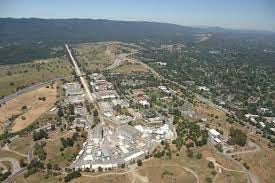
In the mid-1960s a series of experiments were performed at the Stanford Linear Accelerator in California (SLAC). In the SLAC experiments, electrons were accelerated down a three-kilometer long ‘vacuum tube’ by intense radio pulses and then targeted on protons in liquid hydrogen. The results of these experiments showed that electrons were being scattered, or bounced back, from what appeared to be something small and hard within the protons in the hydrogen atoms. From this it was inferred that the protons themselves contained smaller particles.1
Physicists were looking for quarks and naturally concluded that their bombarding particles were bouncing off quarks in the proton so these experiments caused the quark theory to become accepted into mainstream physics and led to a Nobel Prize for Gell-Mann in 1969.The SALC experiments appeared to be supported at CERN, the European Nuclear Laboratory near Geneva. At CERN, protons were being accelerated in vast intersecting rings. At the intersections, energetic protons were directed into head-on collisions. In the high-energy impacts, new particles were formed and came out at right angles to the beams. Again these results seemed to confirm the quark model. However, the SLAC and CERN experiments did not necessarily prove the existence of quarks within the proton. They merely demonstrated that the proton has ‘a hard heart’. The hard heart of a proton could result from its containing not quarks but mesons. Whereas quarks have never been knocked out of protons, in his classic cosmic ray research Cecil Powell did knock mesons out of protons. The hard scattering observed at SLAC and CERN could have been caused by impacts with mesons not quarks.
During World War II physicists succeeded in harnessing the energy locked in the atom to make the most terrible weapons of destruction ever known to mankind. Governments sprinting in the arms race endowed them with virtually unlimited budgets for continued nuclear research. Vast sums of money have been spent on building, maintaining and running massive particle accelerators. Using these, scientists have created a host of new particles accounted for in a nonsense theory. The theory threw up new difficulties and exciting predictions, which required more research and more powerful accelerators.
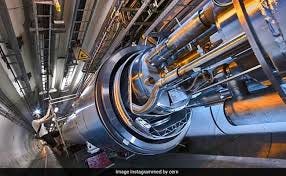
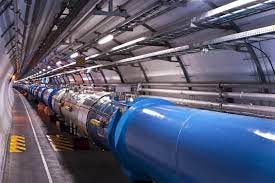
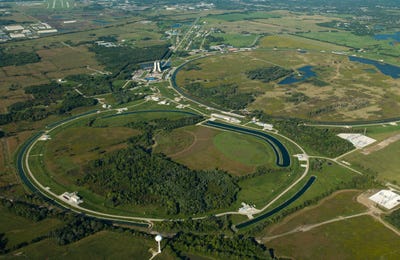
The Large Hadron Collider at CERN in Geneva, costing in excess of eight billion euros, is the biggest and most powerful accelerator in the world. This monster machine is twenty times more powerful than any built previously. Its main purpose is to identify the source of mass – currently believed to be the Higgs Boson - and to simulate the first moments of the Big Bang. It has also been built to further research into quarks and force carrying particles. Creating a new generation of particles this accelerator will lead to more elaborations in the theories, which will require more research and eventually the need for an even bigger accelerator. To prove the predictions of the Grand Unified Theory physicists would need an accelerator as big as the solar system. High-energy research has created an endless cycle in which research physicists create problems for theoretical physicists to solve and they, in turn, predict yet more problems to research. While this elaborate game ensures indefinite employment for scientists and their army of technicians it produces information which is of little relevance or value to the tax payers who have to foot the enormous bill. It is time for a change in physics. Appearing as pillars of truth and harbingers of change, the evidence provided by the neutron and proton could bring quantum theory back to reason and common sense, more in line with the thinking of Einstein than Bohr and Heisenberg.
In The Evolution of Physics published in 1938 1 Einstein wrote:
Belief in an objective reality has led to great scientific advances throughout the ages. Without the belief that it is possible to grasp reality with our theoretical constructions, without belief in the inner harmony of our world, there could be no science. This belief is and always will remain the fundamental motive for all scientific creation.
Writing to Maurice Solovine in 1938 2 Einstein declared:
The necessity of conceiving of nature as an objective reality is said to be an obsolete prejudice while the quantum theoreticians are vaunted. Each period is dominated by a mood, with the result that most men fail to see the tyrant who rules over them.
If experimental physics is to be believed neutrons are formed of electrons attached to protons. If that were so Heisenberg’s uncertainty formula would predict that the certainty of their positions would lead to a wide range of electron velocities. Some would be creeping while others would be racing at nearly the speed of light and most would have a velocity somewhere in between. That would be reflected in a wide range of neutron masses. Experimental physics tells that all neutrons have precisely the same mass. That suggests Heisenberg’s principle is wrong. Science is supposed to be evidence based but for the best part of a century the mood in physics, set by Heisenberg, has been to ignore this evidence in order to save quantum mechanics. Almost to a man physicists have been following the tyranny that determined the neutron is an entirely unique particle without any charge.
They built cathedrals with rings in front - reminiscent of the Vatican - to prove it and from their vaunted position they preached that a weak force changed up quarks into down quarks and that the Universe depends for its existence on their observing it. When Einstein warned that Heisenberg’s uncertainty formula was a witches calculus and the Universe has objective reality the priesthood in the new physics, more akin to religion than science, denounced his call for realism as obsolete prejudice.
Do you think the New Physics is aligned with the ethics and philosophy of science? Do you trust that high energy research has actually proved the existence of quarks and the virtual particles of quantum mechanics or are they just blinding us with science? Do you entertain the possibility that physicists don’t believe in objective reality because they are endeavouring to prove what they believe rather than what is objective reality? For the latter part of his life Einstein was a lone voice in the wilderness crying for common sense and realism. Do you think it is possible he may have been right?
1.Calder N.,, Key to the Universe: A Report on the New Physics BBC Publications 1977
2. Popper K.,, The Logic of Scientific Discovery Hutchinson 1968
3. Dawson J.,, Star Tribune of Minneapolis, May 15th 1994
4. Einstein A., Infeld L., The Evolution of Physics, Simon & Schuster, 1938
5. Solovine Maurice 1987 Albert Einstein Letters to Solovine, New York Philosophical Library.
Well written essay on the subject. I am still struggling to understand Quantum Mechanics. Clearly there is some form of aether or invisible forces that connect elementary particles, cosmic rays, bosons etc. However if there is another time dimension that is outside our reality that would explain the mystery.






Well written essay on the subject. I am still struggling to understand Quantum Mechanics. Clearly there is some form of aether or invisible forces that connect elementary particles, cosmic rays, bosons etc. However if there is another time dimension that is outside our reality that would explain the mystery.